Why Most B2C Travel Portals Fail to Perform
B2C travel portal development often fails because businesses focus only on launching a website. However, success depends on building a conversion-driven system. In reality, many portals collapse under traffic growth due to weak architecture, poor automation, and slow performance.
Moreover, competition from large OTAs makes survival difficult without a scalable strategy. Therefore, a portal must be designed for growth from the very beginning.
What Makes B2C Travel Portal Development Profitable
A profitable portal is not accidental. Instead, it is engineered through structured planning and execution.
Firstly, speed plays a critical role in user retention. Secondly, inventory depth improves booking success. Additionally, seamless checkout flows increase conversions. As a result, revenue grows steadily without excessive marketing spend.
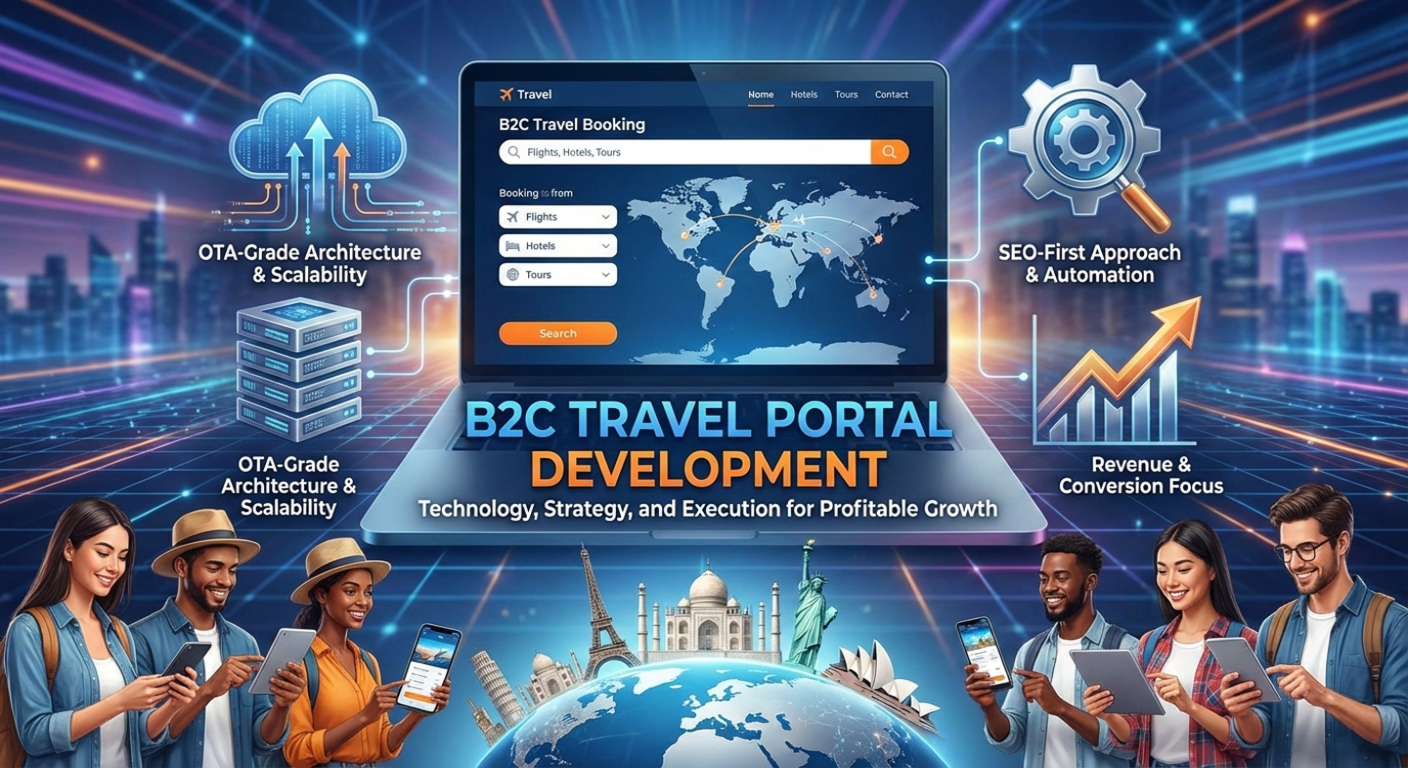
OTA-Grade Architecture in B2C Travel Portal Development
Modular and Scalable Design
Modern development follows a modular approach. For example, search, booking, and payment systems operate independently. However, they remain tightly integrated.
Consequently, updates become easier. Furthermore, scalability improves without disrupting live bookings.
Key modules include:
- Real-time search engine
- Pricing and markup logic
- Booking and ticketing workflow
- Payment and fraud prevention
- Notification automation
Technology Stack That Supports Growth
Technology decisions directly influence performance and SEO. Therefore, high-growth portals use modern frameworks and API-driven backends.
Typically, successful portals rely on:
- Performance-optimized frontend frameworks
- Secure and scalable backend systems
- Caching layers for faster results
- Cloud infrastructure for uptime
As a result, portals handle traffic spikes without downtime.
Common Mistakes in B2C Travel Portal Development
Ignoring Conversion Flow
Many platforms focus on listings only. However, without an optimized booking journey, users drop off before payment.
Depending on Single API Providers
Relying on one supplier limits pricing flexibility. Therefore, multi-API integration becomes essential.
Adding SEO After Launch
SEO added later causes structural issues. Instead, SEO should be integrated during development. Consequently, indexing and ranking improve naturally.
SEO-First Approach to B2C Travel Portal Development
Search visibility determines long-term success. Hence, SEO must be part of the core architecture.
Best practices include:
- Clean and readable URLs
- Fast loading pages
- Mobile-first layouts
- Structured data readiness
As a result, search engines crawl and index pages efficiently.
Custom Development vs Ready-Made Portals
Ready-made portals appear faster to launch. However, they restrict scalability and customization.
On the other hand, custom B2C travel portal development enables brand differentiation, flexible integrations, and advanced analytics. Therefore, serious travel businesses prefer custom solutions.
Why SoftwareXprts Is a Strategic Choice
SoftwareXprts delivers B2C travel portal development with a performance-first mindset. Moreover, platforms are built for automation, SEO, and scalability.
Key strengths include:
- Custom architecture
- Multi-supplier integration
- SEO-ready frameworks
- Secure booking systems
As a result, businesses gain long-term control and growth.
If you want a scalable and revenue-focused platform, the next step is clear.Partner with SoftwareXprts for professional B2C travel portal development and launch a platform built to grow.