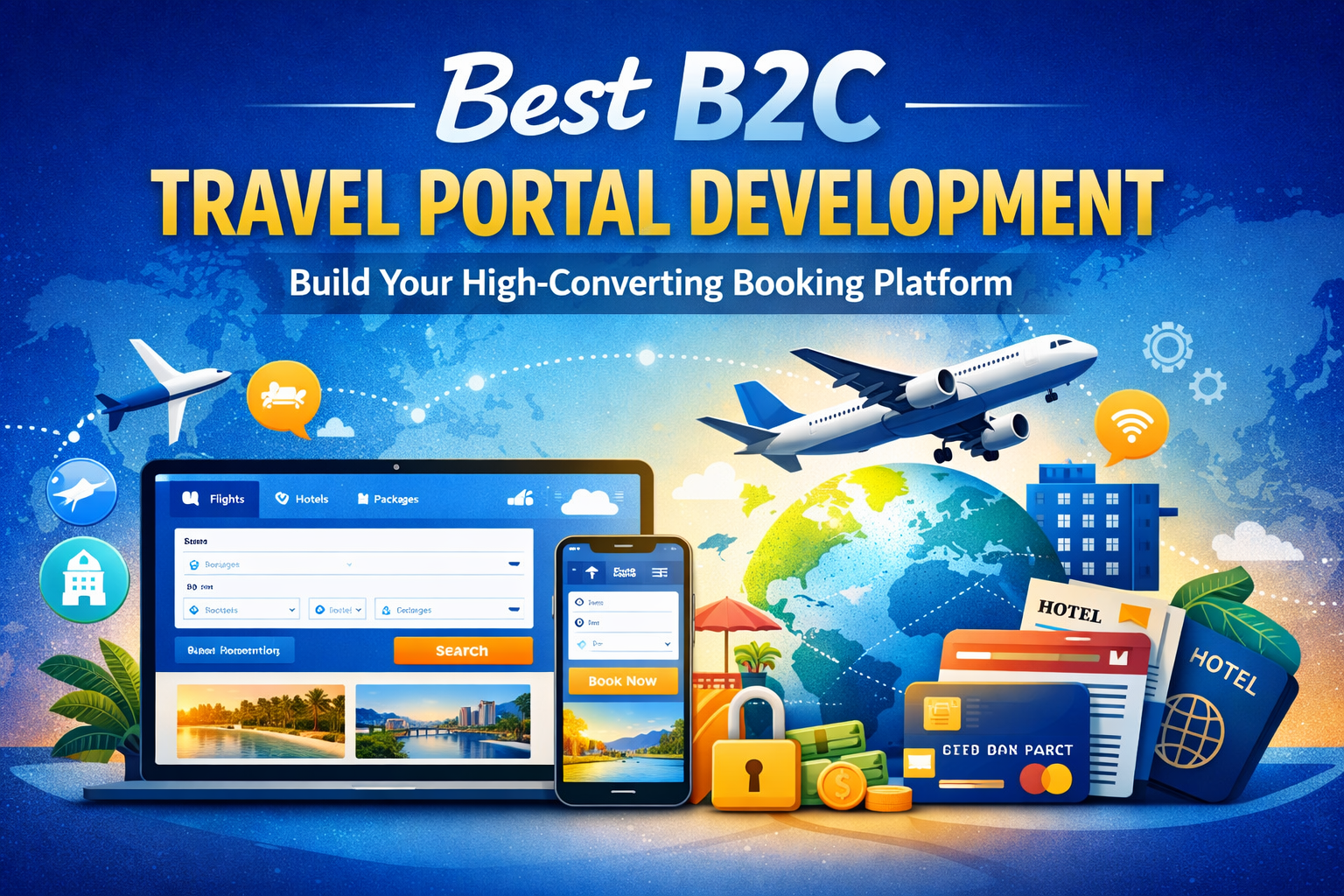
If you want to grow direct bookings and reduce dependency on third-party OTAs, investing in the best B2C travel portal development is the smartest move in 2026. Today’s travelers expect fast search results, real-time pricing, and a smooth booking experience on mobile and desktop.
That is exactly why a B2C travel portal is no longer just a website. Instead, it is a complete digital booking ecosystem that connects flights, hotels, and holiday packages through modern technology.
In this guide, you will learn what makes a B2C travel portal successful, which features matter the most, and how to build a platform that scales.
What is B2C Travel Portal Development?
B2C travel portal development is the process of creating a customer-facing travel booking platform where users can:
- Search and compare flights, hotels, and packages
- View real-time availability and pricing
- Book instantly using secure online payments
- Receive confirmations and manage bookings
- Cancel, reschedule, or request refunds easily
In other words, it helps travel businesses sell directly to customers with a seamless online experience.
Why the Best B2C Travel Portal Development Matters
The travel market is highly competitive. Therefore, even small issues like slow loading or confusing navigation can reduce bookings.
With the best B2C travel portal development, you can achieve:
- Faster booking journeys
- Higher conversion rates
- Better user trust and retention
- Improved mobile performance
- More direct revenue growth
As a result, your portal becomes a strong business asset, not just a digital presence.
Key Features of the Best B2C Travel Portal
To build a portal that performs well on Google and converts visitors into customers, you need the right features. Moreover, every feature should support speed, trust, and user experience.
1) Fast Search and Smart Filters
First of all, search speed directly impacts conversions.
A high-performing B2C travel portal should offer:
- Advanced filters (price, stops, airline, ratings, amenities)
- Sorting options (cheapest, fastest, best value)
- Flexible date and fare calendar view
- Auto-suggestions for destinations
Because users want results instantly, your search system must be optimized for performance.
2) Real-Time Flight and Hotel API Integration
Secondly, real-time data is the backbone of travel booking.
The best portals support:
- Flight API or GDS integration
- Hotel supplier integrations
- Holiday package inventory management
- Add-ons like transfers and activities
As a result, customers see accurate prices and live availability, which reduces booking failures.
3) Mobile-First UI/UX Design
Nowadays, most users book travel through mobile devices. Therefore, mobile-first design is essential.
Your portal should include:
- Responsive layouts for all screens
- Minimal steps to complete booking
- Clear CTA buttons and smooth navigation
- Fast-loading pages with optimized assets
In addition, a mobile-friendly portal also improves SEO because it reduces bounce rate.
4) Secure Payment Gateway and Multi-Currency Support
Next, the checkout experience decides whether users complete the booking.
A professional B2C travel portal should provide:
- Secure payment gateway integration
- Multi-currency support
- Automated invoice and receipt generation
- Email/SMS payment confirmations
Consequently, users feel confident while paying, which improves conversions.
5) User Accounts and Booking Management
After booking, customers want control. That is why user accounts are critical.
Key modules include:
- Login/signup via email or OTP
- Booking history and upcoming trips
- Cancellation and refund tracking
- Saved travelers and preferences
As a result, your portal builds loyalty and increases repeat bookings.
6) Offers, Coupons, and Promotions
In travel, discounts influence purchase decisions. However, pricing transparency matters equally.
Your portal should support:
- Promo codes and coupon management
- Seasonal offers and deal banners
- Transparent tax and fee breakdown
- Bundled package discounts
Therefore, users get both value and clarity during checkout.
7) Admin Dashboard for Business Control
Finally, a strong admin panel helps you scale operations efficiently.
A powerful admin dashboard should include:
- Booking and revenue reports
- Markup and commission controls
- Supplier and inventory management
- Offer management and content updates
- Analytics for performance tracking
Because business growth depends on control, admin features should be built properly from the start.
Best Tech Stack for B2C Travel Portal Development
To build a scalable and future-ready platform, you need modern technologies. Additionally, the stack must support fast search, API integrations, and secure payments.
Recommended tech stack:
- Frontend: React / Next.js
- Backend: Node.js / .NET / Python
- Database: PostgreSQL / MongoDB
- Search Engine: ElasticSearch
- Cloud Hosting: AWS / Azure
- API Layer: REST + GraphQL
As a result, your portal remains stable, fast, and easy to upgrade.
Custom vs Ready-Made B2C Travel Portal: Which is Better?
Many travel businesses start with ready-made solutions. However, they often face limitations when scaling.
Ready-Made Travel Portal
Pros:
- Faster launch
- Lower initial cost
Cons:
- Limited customization
- Restricted API integrations
- Difficult performance optimization
- Dependency on vendor updates
Custom Travel Portal Development
Pros:
- Full control over UI/UX
- Flexible supplier and API integrations
- Better SEO and speed optimization
- Scalable architecture for future growth
- Stronger security and compliance
Therefore, if you want long-term growth, custom development is the better strategy.
Cost of the Best B2C Travel Portal Development
The cost depends on portal features, integrations, and complexity. Still, you can plan your budget with realistic ranges.
Typical development cost:
- Starter portal: ₹3L – ₹7L
- Mid-level portal: ₹8L – ₹18L
- Advanced portal: ₹20L+
However, the best approach is to build in phases:
MVP → Integrations → Automation → Scaling
This way, you launch faster while keeping development under control.
Why Choose SoftwareXprts for B2C Travel Portal Development?
At SoftwareXprts, we focus on building portals that are scalable, conversion-driven, and business-ready. Moreover, we ensure your portal performs well on both user experience and technical performance.
Our development approach includes:
- UI/UX strategy for higher bookings
- Real-time API integration planning
- Secure payments and scalable architecture
- Admin panel and analytics setup
- Post-launch support and upgrades
As a result, you get a B2C travel portal that competes with modern travel platforms.
Final Thoughts
In conclusion, the best B2C travel portal development is about building a platform that is fast, secure, mobile-friendly, and powered by real-time APIs. Most importantly, it should deliver a smooth booking experience that turns visitors into customers.
So, if you are planning to launch a new B2C travel portal or upgrade your existing platform, focus on performance, integrations, and user experience from day one.
If you want to build a scalable and high-converting travel booking platform, check our best B2C travel portal development services here:
https://www.softwarexprts.com/b2c-travel-portal