
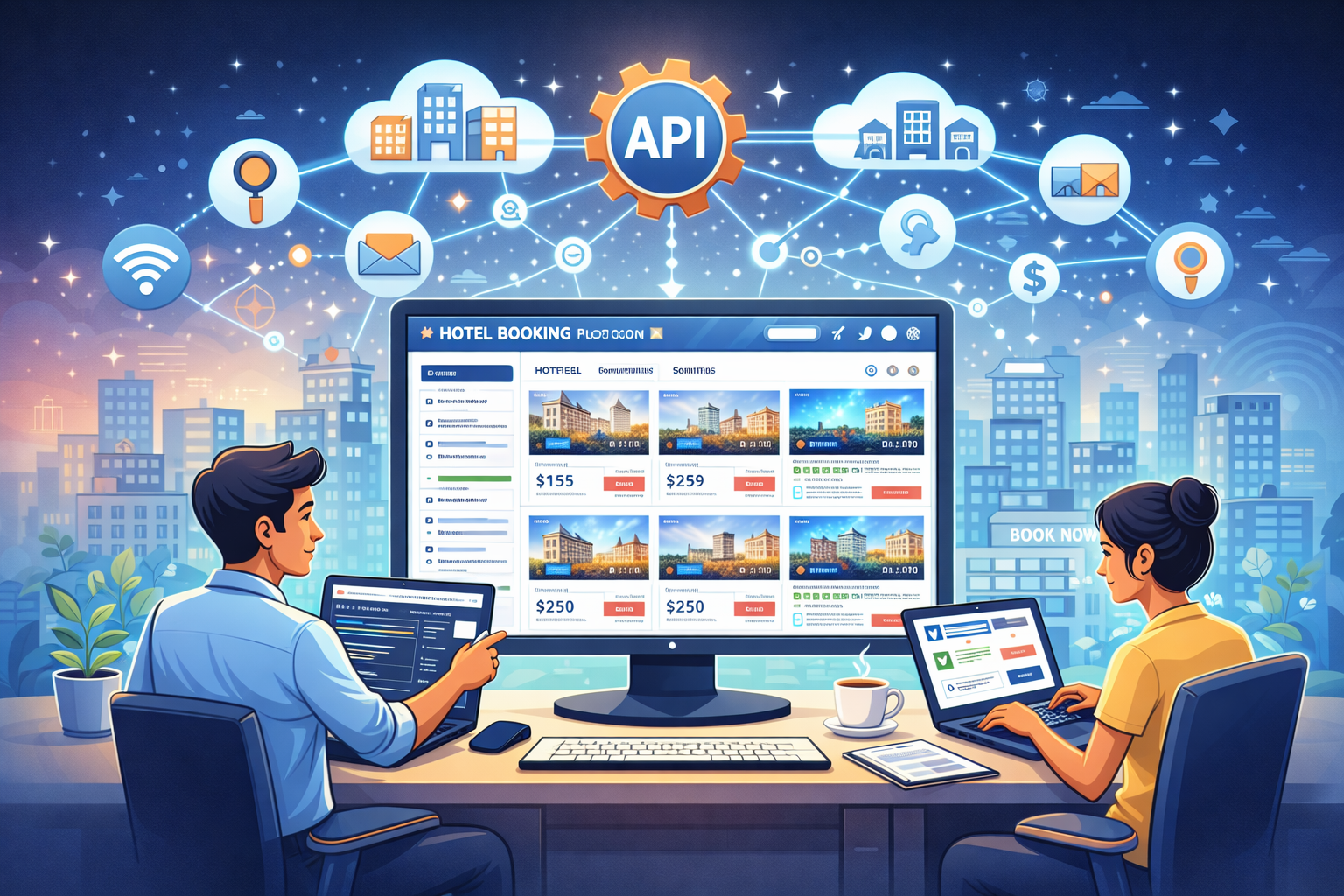
In today’s digital travel market, customers expect instant hotel availability, real-time pricing, and seamless booking experiences. Therefore, travel businesses must rely on advanced technology to stay competitive. One of the most effective ways to achieve this is through a reliable hotel booking API integration guide that connects platforms directly to global hotel suppliers.
Moreover, APIs eliminate the need for manual contracting with individual hotels. As a result, companies can scale quickly while offering a wider selection of properties worldwide.
What Is Hotel Booking API Integration?
Hotel booking API integration enables travel platforms to access hotel data from suppliers in real time. In other words, it allows your website or app to search, display, and book hotel rooms instantly.
Through proper integration, businesses can:
- Retrieve live room availability
- Compare rates across suppliers
- Show detailed hotel information
- Confirm bookings instantly
- Manage cancellations and changes
Consequently, travel companies can deliver a seamless booking experience without maintaining their own inventory.
Why Travel Platforms Depend on Hotel APIs
Manual hotel sourcing is slow and difficult to scale. However, modern travelers expect immediate results across thousands of options.
With hotel API integration, platforms gain:
- Access to global hotel inventory
- Real-time pricing updates
- Automated booking workflows
- Faster search performance
- Reduced operational workload
Overall, APIs serve as the foundation of modern online hotel distribution.
Types of Hotel APIs Used in Integration
Different providers offer different capabilities. Therefore, selecting the right combination is essential for performance and coverage.
1) Aggregator APIs
Aggregator APIs combine inventory from multiple hotel suppliers. As a result, a single integration can provide access to millions of properties worldwide.
2) Direct Hotel APIs
Direct integrations with hotel chains offer exclusive benefits. For example, businesses may receive better pricing, richer content, and improved availability compared to aggregator sources.
3) Content APIs
Content APIs supply images, descriptions, amenities, and location details. In addition, they enhance listing quality and improve user trust during the booking process.
Key Features of a Successful Integration
Not all integrations deliver the same results. Instead, a high-performing system must include several critical capabilities.
A robust hotel booking API integration should provide:
- Fast search response times
- Intelligent caching mechanisms
- Multi-currency support
- Secure payment processing
- Reliable booking confirmations
- Strong error handling
Without these features, even powerful APIs may fail to deliver a smooth experience.
Common Challenges During Implementation
Despite their benefits, hotel APIs can be complex to integrate. For instance, differences in rate rules, availability formats, and data structures often create challenges.
Common issues include:
- Slow search results
- Pricing discrepancies
- Availability mismatches
- Booking failures
- Complex cancellation policies
Nevertheless, these problems can be minimized through proper architecture and testing.
How Hotel API Integration Drives Business Growth
When implemented correctly, hotel APIs provide significant competitive advantages. First, they enable instant expansion into new markets. Second, they reduce manual effort and operational costs. Finally, they improve customer satisfaction through faster booking experiences.
As a result, travel businesses can:
- Increase conversion rates
- Offer competitive pricing
- Scale globally without infrastructure overhead
- Improve customer retention
Choosing the Right Integration Partner
Integration is not just a technical task. Rather, it is a strategic investment that impacts long-term growth.
Businesses should evaluate providers based on:
- Experience with travel APIs
- Scalability of architecture
- Performance optimization
- Reliability and support
- Security standards
Final Thoughts
A well-planned hotel booking API integration guide helps travel companies avoid costly mistakes and launch scalable platforms faster. Ultimately, API-driven systems are the backbone of modern hotel distribution.
For businesses aiming to deliver seamless booking experiences and expand globally, investing in the right integration strategy is essential for long-term success.
Frequently Asked Questions
What is hotel booking API integration?
Hotel booking API integration connects travel platforms to hotel suppliers, enabling real-time search, pricing, availability, and instant booking of hotel rooms.
Why do travel businesses need hotel API integration?
It provides access to global hotel inventory, automates booking workflows, improves pricing accuracy, and enhances user experience.
Which platforms use hotel booking APIs?
Online travel agencies, B2B portals, corporate booking systems, and travel startups use hotel APIs to scale hotel offerings quickly.
How long does hotel API integration take?
Integration timelines vary from a few weeks to several months depending on complexity, customization, and supplier requirements.